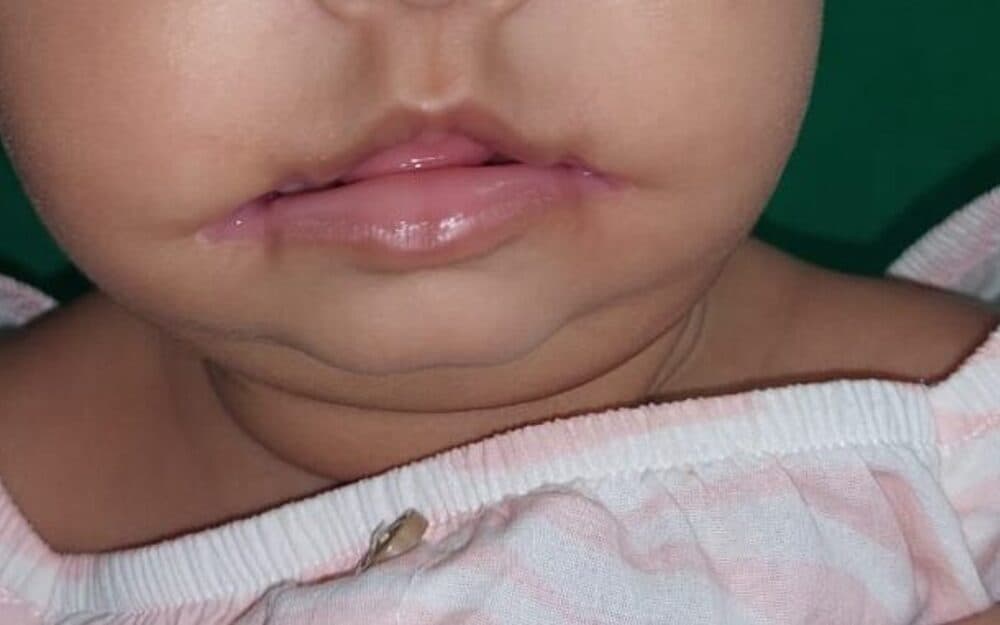
Palatoplasty for a cleft of the palate
A cleft of the palate closed on a mouth gag, restoring a continuous palate and repositioning the muscle so that speech could develop.
Cleft surgery · Face · Child · 5 min read
- Mechanism
- Congenital
- Anaesthesia
- General
- Stages
- Single stage
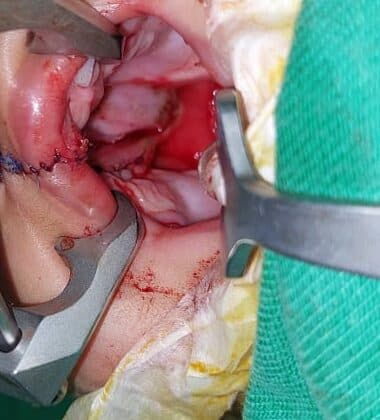
Presentation
The child presented with a cleft of the palate. Unlike the lip, this is not primarily a question of appearance: an open palate means food and air escape into the nose, and speech that develops around an incompetent palate is difficult to correct later by any operation. Timing therefore matters more here than almost anywhere else in reconstructive surgery.
Cleft of the palate with the palatal muscle inserting abnormally onto the posterior edge of the hard palate rather than meeting in the midline. Airway and feeding assessed pre-operatively; exposure obtained on a mouth gag with the child supine and the head extended.
Procedure
Exposure was obtained on a mouth gag, which in a small child is the step that determines whether the rest of the operation is possible. The cleft margins were incised and the layers closed separately, and the palatal muscle was dissected off its abnormal insertion on the hard palate and repositioned across the midline. That muscle repositioning is the part that produces a palate which functions rather than one which is merely closed: a watertight closure with the muscle left where it was gives a child who still cannot make the sounds.
- AssessmentPalate examined; airway and feeding assessed
- OperationPalatoplasty with repositioning of the palatal muscle
- Follow-upSpeech review — records to be supplied
Outcome
The palate was closed with the muscle repositioned. Speech development, velopharyngeal competence and the need for secondary surgery are placeholder — those are follow-up findings and await the surgeon’s records.
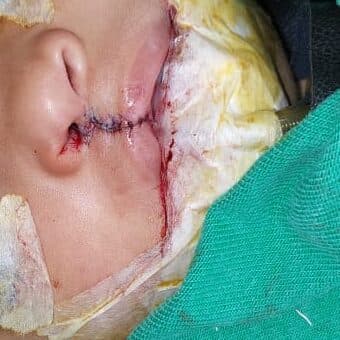
Clinical images are blurred until you choose to view them. Each is labelled with its timepoint.
Placeholder — to be replaced with the words of the child’s parents, given with consent.
Surgeon's note
Palate closure cannot be deferred the way lip repair can, because speech does not wait for the operating list. The technical point is the muscle: closing the cleft in layers without taking the levator off the posterior hard palate and reorienting it produces a closed palate that still does not work, and the child comes back years later needing a second operation for speech. The judgement is between operating early enough for speech and late enough for the airway to be safe.
Consent
CONSENT PENDING — this photograph is published for build purposes only and must not go live until written consent is on file. Parental consent is required for a paediatric case.
These cases are published for clinical and educational purposes. Every patient, injury and recovery is different: the results shown are individual outcomes and are not a prediction or guarantee of the result of any other person’s treatment. All surgery carries risk, which is discussed in full during consultation.